Make a Household Task List That Stays Usable
Build a household task list around clear finishes, useful cues, and shared responsibilities. A worked example shows how to make the list specific without turning it into another project.
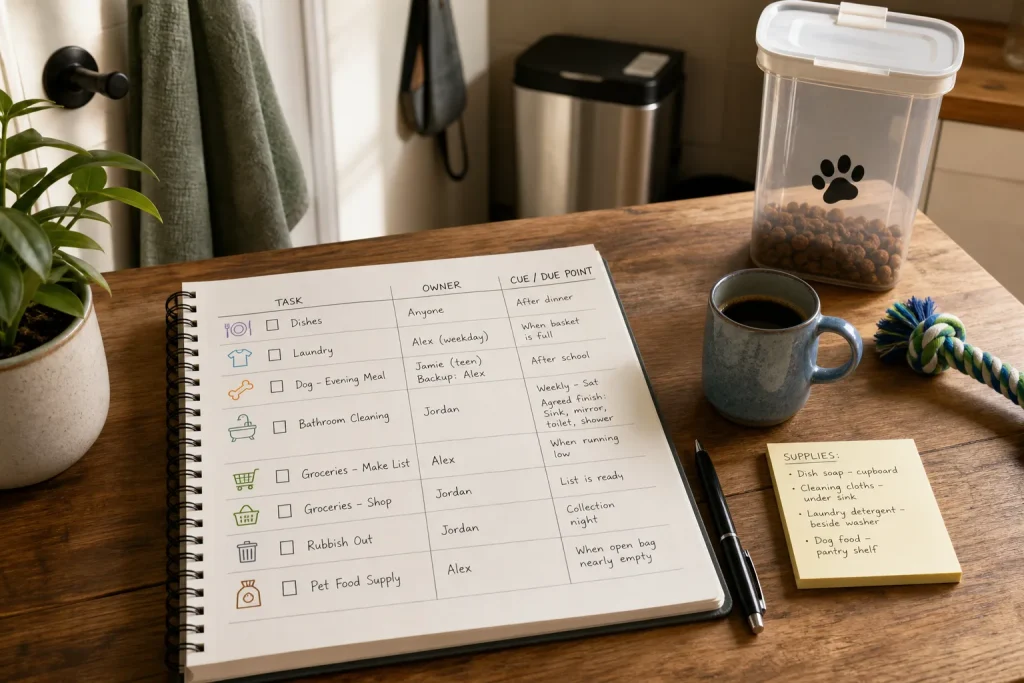
A damp towel is draped over the bathroom door, the dog’s food bin is nearly empty, and nobody knows who planned to take the rubbish out. A household task list can make these ordinary handoffs visible, but only if it answers practical questions: what needs doing, what counts as done, and who notices when it is due?
Think of the list as a set of household agreements, not a scorecard. It should reflect the work people have actually agreed to do, give each task a clear finish, and make exceptions easy to discuss. A short list posted where routines happen is often more useful than an exhaustive inventory that no one checks.
Write down recurring work as it appears
Start with the tasks that regularly interrupt household life: dishes, laundry, bathroom cleaning, rubbish, groceries, pet care, and replenishing supplies. For several days, keep a scrap of paper near the kitchen and add jobs when someone notices them. Include small recurring irritants, such as muddy paw prints by the entrance, but leave one-off repairs on a separate note.
Combine duplicate descriptions. “Wash towels” and “put out clean towels” can become one task if the same person completes both parts. Write the finish in observable terms: “wash, dry, and put away one load” is clearer than “deal with laundry.” If different people routinely handle the parts, list them separately so responsibility does not disappear between steps.
Add an item only when its absence causes a problem or the household has agreed it matters. This keeps the list from becoming a catalogue of ideal chores. It also gives household members a chance to discuss whether an unlisted job really belongs in the routine.
Give each task a cue and a stopping point
A due date is not always the best reminder. “Take rubbish out on collection night” has a clear cue; “replace the dog-food bag when the open one is nearly empty” depends on a visible condition. Choose wording that tells the owner when to act, such as “after dinner,” “before school,” or “when the empty container is on the shopping shelf.”
For each task, agree on the minimum acceptable result. “Clean the bathroom” might mean wiping the sink and mirror, cleaning the toilet, and rinsing the shower. If the household means something else, spell it out. Also note where necessary supplies are kept, such as cloths under the sink or detergent beside the washer. A clear finish and nearby materials reduce the chance that someone will have to guess or stop midway.
Group tasks by their natural rhythm, using labels such as daily, weekly, or occasional. These labels are prompts, not rigid standards. A task that depends on a condition should say so instead of being forced into a calendar slot. If the cue is hard to notice, choose a more visible signal or assign someone to check it at a sensible time.
Choose ownership that fits the people involved
An owner is responsible for noticing the cue, doing the task, and raising a problem if it cannot be completed. A helper contributes when asked but does not carry the reminder by default. Naming this difference prevents the household from treating the person who remembers everything as an invisible coordinator.
Assignments should fit people’s schedules, abilities, and responsibilities. A teenager might be able to feed a pet after school but not drive to a shop. An adult who is home during the day may find it easier to start laundry, while another person may prefer grocery shopping. These are household-specific decisions, not rules about who should do which kind of work.
Some tasks can be shared, but say what “shared” means. For a grocery trip, one person might make the list and another might go to the shop. For a task that cannot wait if the owner is absent, name a backup and state when that person takes over. If nobody can own a job reliably, change its timing or agreed finish rather than leaving an assignment that exists only on paper.
Make the list easy to check and revise
Use a place or tool that household members already notice. A sheet on the refrigerator may suit a home where people gather in the kitchen; a shared digital list may work if everyone checks it. Avoid adding a new app just to display tasks if opening it is likely to become another chore.
Keep the display simple. A paper list can use three columns: task, owner, and cue or due point. Add a supply note only where it helps someone act, such as “dish soap: check cupboard before shopping.” Use check boxes for tasks where a mark answers a useful question, such as whether the current bathroom clean is done. Do not add tracking for every repetition if it makes routine work harder to see.
When a task is missed, ask what the list failed to communicate before adding reminders. Was the cue easy to notice? Was the finish clear? Did the owner’s schedule change? Revise the part that caused confusion. For health, mobility, or other personal constraints that affect what someone can safely do, discuss suitable adjustments with the person involved and seek qualified advice where needed.
Work through a hypothetical household arrangement
Hypothetical worked example: Imagine a household with two adults, a teenager, and a dog. One adult works from home on weekdays, the other returns late on some evenings, and the teenager is available after school. The starting list assigns the first adult all laundry, the dog’s meals, and bathroom cleaning; the second adult handles groceries and rubbish; the teenager has no listed task. The first adult says the weekday load feels too heavy, while the teenager says they did not know what was expected.
They take these actions. First, they define the laundry task as “wash, dry, and put away one load” and leave it with the adult whose weekday schedule allows it. Second, they move the dog’s evening meal to the teenager, with the adult who is home as backup if the teenager is away. Third, they keep bathroom cleaning with the second adult and write down the agreed finish: sink, mirror, toilet, and shower. Fourth, they keep the grocery trip shared by assigning one person to make the list and the other to shop. Fifth, they attach rubbish to collection night and place the pet-food supply cue beside the shopping list.
The resulting arrangement has named owners, clear finishes, and a backup for the pet-care task. The teenager has a bounded responsibility, while the adult who had too many jobs no longer owns the evening meal. The tradeoff is that grocery shopping still depends on coordination, so the two adults need to communicate if either part cannot happen. That is a specific handoff to manage, rather than an unspoken expectation that one person will notice and cover everything.
Use a short decision check when the list stalls
When the list stops helping, check the relevant item and make a direct change. These checks are prompts for a conversation, not a way to judge whether someone has tried hard enough.
- Check whether the task names an observable finish. If it does, keep the wording; if it does not, write the agreed actions and result before assigning it.
- Check whether the cue is easy to notice. If it is, keep it; if it is easy to miss, tie the task to a visible condition or an existing routine.
- Check whether the listed owner can do the task at the stated time. If they can, leave the assignment; if they cannot, change the timing or choose another willing owner.
- Check whether the tools and supplies are available where the task happens. If they are, leave them in place; if they are not, name a storage location or add a supply reminder.
- Check whether a backup is needed because the task cannot wait. If it is, name who steps in and under what condition; if it is not, leave the task with one owner rather than adding unnecessary oversight.
- Check whether the task still solves a household problem. If it does, keep it; if it no longer matters or has become a one-off, remove it from the recurring list and record it elsewhere only if needed.
Review the list when schedules or household needs change, rather than waiting for frustration to build. A useful list makes the next action and its owner easy to see; it also makes it easier to spot when an arrangement no longer fits. Keep the recurring list focused, and let unusual projects live somewhere separate so routine care remains manageable.
More useful reads

A Few Questions for Comparing Competing Options
A focused comparison can clarify what matters, what each option demands, and which missing detail could…

Start a Creative Project Before You Feel Ready
Compare three low-pressure ways to begin: make a rough fragment, build a tiny prototype, or collect…