Start a Creative Project Before You Feel Ready
Compare three low-pressure ways to begin: make a rough fragment, build a tiny prototype, or collect source material. Choose the first session that fits your idea and energy.
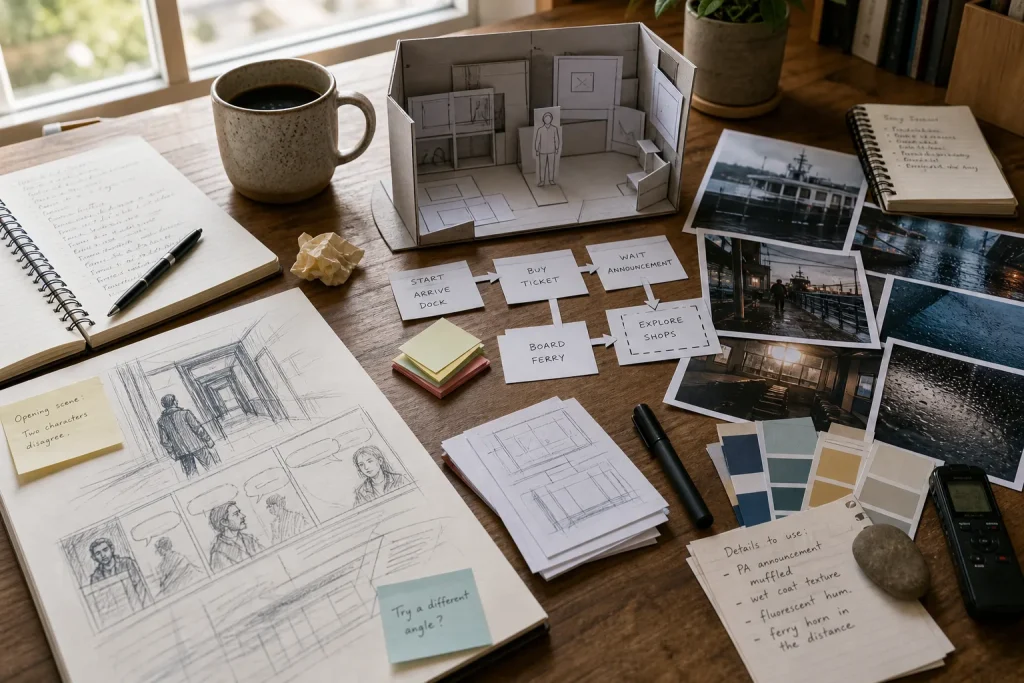
You have a melody in your head, a story premise in a notebook, or a half-formed idea for a small game. The project feels promising, but the first move seems to demand a plan for everything that follows. Instead, treat the first session as a way to learn what the idea needs. A useful outcome might be a rough page, a paper model, or a short folder of references—not a polished work or a pledge to finish.
Three approaches make that first session manageable: create a rough fragment, build a tiny prototype, or gather a focused set of source material. Each suits a different kind of uncertainty. The best choice is the one that brings the main question into view without requiring you to solve the whole project first.
Choose a first session by the uncertainty you have
Before opening a blank document, name what is unclear. Is it hard to picture the finished work? Do you know what you want to make but not whether the form will work? Or are you missing the images, sounds, or facts that would give you something to respond to? This is not a demand for a full brief. One plain sentence is enough: “I don’t know how the narrator sounds,” or “I can’t tell whether this cardboard structure will stand.”
That sentence points toward a suitable starting approach. If the uncertainty is about voice, mood, or direction, a rough fragment offers immediate material to react to. If it concerns an interaction, shape, or sequence, a prototype can expose practical problems. If the idea depends on a setting, subject, or visual language you have not explored, a small collection of sources can provide useful boundaries.
Keep the first session’s outcome observable. “Work on my comic” is hard to judge because it leaves the task open-ended. “Draw one rough panel showing the character entering the room” describes something you can see when you stop. A clear outcome is not a measure of artistic worth; it is a stopping point that makes a beginning easier.
Make a rough fragment when the idea needs a voice
A fragment is a small piece of the intended work made before you know what the whole thing will become. It might be a paragraph of fiction, a chorus, a thumbnail sketch, a short dialogue, or a few lines of a speech. This approach suits ideas whose main obstacle is choosing a direction. Once something exists, even in an awkward form, you can respond to its tone and details instead of judging an abstract possibility.
Pick one narrow moment rather than beginning at the beginning. For a story, write the exchange where two characters disagree. For a song, try the phrase that keeps returning to mind. For a drawing, sketch the object that gives the scene its distinctive shape. Leave gaps, use temporary wording, and mark uncertain parts in brackets. You are making a sample, not a contract with the finished piece.
The advantage is feedback from your own attention: you can notice what feels lively, dull, or surprising. The tradeoff is that a fragment may not answer practical questions about how the larger work functions. A vivid opening paragraph does not tell you how a branching story will behave, and a pleasing melody does not settle the arrangement.
Choose this approach if you already have a clear image, phrase, scene, or moment and need a way to follow it. If you repeatedly polish the same sentence, change the constraint: write the scene as dialogue, draw it as a sequence of boxes, or make a deliberately clumsy version. The purpose is to create something that can be revised, not to perfect a small piece until it becomes another source of pressure.
Build a tiny prototype when the form is uncertain
A prototype is a simple, temporary version made to examine how an idea works. It can be a paper mock-up of a zine, a cardboard layout for a display, a clickable sketch in a slide deck, or a few index cards representing the stages of a game. Its materials can be ordinary. The important feature is that it makes a question visible through an object or sequence.
Start with one question the prototype can help you consider. Could a reader understand the order of these pages? Does the player have a meaningful choice at this point? Can the object fit the space you have in mind? Keep the mock-up limited to the parts needed to explore that question. Decorative details, final materials, and polished artwork can wait until you know they matter.
This approach suits work with spatial, interactive, or structural uncertainty. It is also useful when a description keeps getting longer without making the idea easier to picture. A rough physical or digital version gives you something concrete to alter. The tradeoff is that making the prototype can become a project of its own. If you find yourself adjusting colors or adding features unrelated to your question, return to the one thing the mock-up is meant to reveal.
Use cheap, reversible materials where possible: scrap paper, a pencil, sticky notes, a basic drawing app, or a slide deck. When a choice is easy to undo, you can try alternatives without treating any one version as final. Stop when you can describe what the current version makes clear and what remains uncertain.
Gather source material when the idea lacks a foothold
Sometimes the difficult part is not making a fragment or prototype, but having too little to respond to. A focused collection of source material can supply that foothold: reference photographs, field notes, a list of observed details, sound recordings, color swatches, or a small set of objects arranged on a desk. This approach suits projects that depend on a particular place, subject, atmosphere, or visual vocabulary.
Define the collection by the question it serves. For a story set in a ferry terminal, you might gather details about the sound of announcements, the texture of wet coats, and the way passengers wait. For a collage, you might collect images with similar shapes but contrasting colors. The aim is not to assemble an impressive archive. It is to find a few concrete details that can enter the work.
Give the gathering session a boundary: one location, one theme, or one kind of reference. Save sources in a folder with short labels, or jot down what caught your attention beside each item. If you are using material created by others, keep track of where it came from and respect applicable permission and attribution rules before publishing or distributing work based on it.
The benefit is that specific details can make a broad premise easier to handle. The tradeoff is that collecting can feel productive while postponing the act of making. End the session by choosing one item to use in a fragment or prototype next time. If you already have plenty of references, do not gather more merely to avoid an uncertain first draft.
Compare the approaches without turning them into a test
These options are not stages that everyone must follow in order. They are different ways to give an idea a workable shape. A fragment is strongest when the project needs a voice or moment. A prototype is strongest when the question concerns form or function. A source collection is strongest when the work needs a richer sense of its subject or setting.
Use three simple questions to choose. First, what is the most pressing unknown? Second, what small thing could make that unknown easier to see? Third, which approach can you begin with the materials already available? If two approaches seem equally suitable, choose the one with the clearest stopping point. You can switch approaches after the first session; you are selecting an opening move, not committing to a method for the entire project.
Avoid choosing by asking which approach sounds most impressive. An elaborate prototype may be unnecessary if a few paper boxes answer the same question. A folder of references may be less useful than one rough scene if the voice is the real obstacle. The right first session is not the one that looks most like professional production. It is the one that gives you information you can use in your next decision.
Hypothetical worked example: a small illustrated story
Starting situation: Imagine you want to make a short illustrated story about a child who discovers a garden growing on an apartment roof. You have a notebook, a pencil, and a basic drawing app, but no settled plot. You can spare one brief session and do not want to commit to a full sequence of pages.
Choice and action: The main uncertainty is what makes the discovery feel surprising, so you choose a rough fragment rather than a prototype or a large reference search. Write three rough lines describing the child opening the roof door, then sketch one panel showing what appears beyond it. Add temporary labels for details you have not decided, such as the plants or time of day. Leave the panel unpolished.
Expected result and tradeoff: At the end, you have one visible moment and can tell whether the story’s appeal lies in the garden itself, the child’s reaction, or the contrast with the apartment building. You still do not have a complete plot or finished artwork. That is the tradeoff: the session narrows the next question rather than resolving the whole project. If the panel reveals that the garden’s layout is hard to imagine, a simple paper prototype could be the next useful move.
Set a stopping point that leaves room to return
Before you begin, write a short description of what will count as enough for this session: “one rough chorus,” “a paper layout of the opening,” or “a handful of details from one place.” When you reach it, pause and note one thing you learned and one question to carry forward. A sentence such as “The scene works better when the character hesitates; I still need to decide what they hear” preserves momentum without demanding another hour of work.
Make the next action small enough to recognize, too. Instead of writing “continue story,” leave a note to “draw the view from the roof door” or “try the dialogue without narration.” This gives you a clear re-entry point if you return later. A creative project does not need to feel ready before you begin; it needs a first session whose result is small enough to make, specific enough to notice, and useful enough to shape what comes next.
More useful reads
A Few Questions for Comparing Competing Options
A focused comparison can clarify what matters, what each option demands, and which missing detail could…
Make a Household Task List That Stays Usable
Build a household task list around clear finishes, useful cues, and shared responsibilities. A worked example…